Writer: Neal Shaffer
Artist: Luca Genovese
Publisher: Oni Press

It’s pretty simple, I think, for readers out there to figure out whether they’re going to like Oni Press’ new horror graphic novel, The Awakening: if you like giallo, especially Dario Agento’s Suspiria, you’ll like The Awakening.

But that may be the only way you’ll like it.

Giallo is the well-known Italian horror subgenre that grafts mystery, serial killers, and sometimes supernatural elements together to create a unique form. Gialli (as the plural goes) tend to feature elaborate kill scenes, substantial misdirection about the killer’s identity, and a strong current (whether overt or subtextual) of sex.

They also feature, in many cases, bad acting, bad overdubbing, and silly plots.

The Awakening is made from healthy doses of all of the elements that create a giallo.

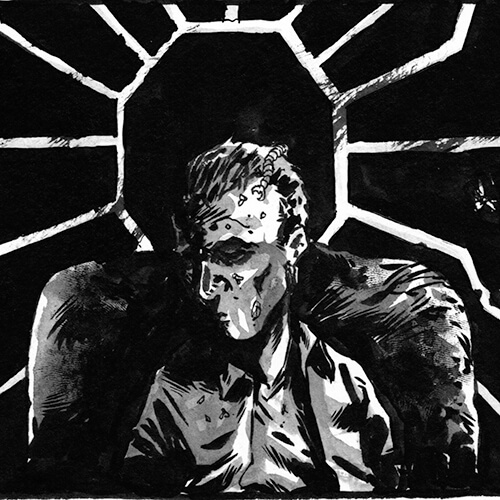
The story follows new-girl-at-school Francesca, an Italian transfer student to the storied and prestigious Grenrock Academy. After arriving and making some friends, things go strange: one of her friends is murdered in the school parking lot and when she tries to stop the murder, she’s also attacked and sent into a coma.

It’s while in a coma – a strange place for a story’s main character to be for most of the graphic novel, by the way – that she develops the ability to foresee the murders of her other friends at school. In the finest giallo tradition, how these powers work or where they come from is never explained.

Meanwhile, machinations at the school hint at a deeper connection to some past horror and some secret society that both runs the school and may be causing the murders. Again, like in any good giallo, none of this is really explained either. We’re just given pieces of the information and asked to accept that it makes sense.

The rest of the story is spent on the various girls that Francesca is friends with being picked off by the murderer, as well as Francesca, now out of her coma, teaming with a police detective to catch the killer (SPOILER – who is drawn to look a lot like Steve Jobs. So much, in fact, that I kind of thought the character was supposed to be the real-life Steve Jobs he first appeared).

The Awakening might be an interesting story if there were more to it, and if its influences weren’t so bare, but the work is just never developed enough to let it stand on its own.

The book is full of maddening holes – why are the murders happening, why is the murderer killing, who is the group of elders behind the school, what connection do these murders have to the earlier ones? This seems like pretty crucial information in this kind of story, but Shaffer and Genovese leave it all out. (Other recent graphic novels from Oni have been about 40 pages longer than this one. With that space, the story could have been much more fully realized.)

Compounding the frustration is that anyone who has seen Suspiria (and I’d wager a lot of horror fans have – it’s considered a classic) will recognize many, many parallels between the two works.

Suspiria is about a foreign student coming to a new, ancient school. So is The Awakening.

Suspiria has a killer who goes largely unseen for most of the film. So does The Awakening.

Suspiria features a strange cabal running the school from behind the scenes. So does The Awakening.

The similarities simply make The Awakening too familiar to be frightening or surprising.

Its lack of crucial information, detailed characters, and resolved story lines ultimately make it a deeply disappointing work.

Buy The Awakening At Amazon.


There’s a good little discussion kicking across a few sites and blogs right now about whether comics actually have the capacity, as a medium, to scare people.

The things was kicked off by an article by Nate Southard and picked up on by Kevin at Thought Balloons and Dorian at Postmodern Barney. I figure this is the territory I’m walking, and Kevin asked my opinion, so I thought I’d drop my two cents in the bucket of blood.

For my money, comics can scare the audience just as well as any other medium, it’s just that most horror comics don’t even bother to try to scare people.

Southard’s contention is that horror works best when it can appeal to the imagination, rather than the strictly visual (his example of Lovecraft is dead on: How scary would Lovecraft’s monsters be if we could actually see on the screen or the page? He’s right: Not very. In real life, of course…), that it is well-served by sound, that fear is almost impossible to generate with an image.

It’s an interesting argument, and he’s right about some things.

Dorian then picked up the argument, saying a lot of what I would have said if I’d posted sooner (beaten to the punch!): that modern horror comics are too concerned with using existing archetypes that have been stripped of their power to frighten (the vampire, the zombie, etc.), that much of modern horror is nostalgia for things that used to scare us.

He sums it up best, though, when he says: “I think the real problem with horror in comics is that most of what is called horror isn’t very good.”

This, I think, is the biggest problem with horror comics not scaring people. ‘Cause I read a lot of horror comics, and most just aren’t that good. Pretty simple.

On top of that, hardly anyone seems to be actually trying to scare anyone with their horror comics. I mean for all the press Kirkman and Niles get, are they trying to scare anyone, or are they using existing horror archetypes, ideas, and properties to tell whatever other story they want to tell? Is anyone seriously frightened by The Walking Dead? If so, do they ever leave the house? I don’t think Kirkman is even trying to scare with it – I think he’s trying to examine human relationships and interactions using horror trappings as his instrument.

Even some of my favorite horror comics – The Goon, Love Eats Brains, Runoff- are not really trying to scare people. They’re telling odd tales, unsettling tales, transcendent ones, but not really scary ones, and I think their creators would agree that they haven’t set out to scare anyone.

I hate to sound like a broken record, or an echo of Dorian, but the only comics I’ve ever found scary were those of Junji Ito. In this distinctly visual medium, his art is the most disturbing, creepy work I’ve seen, work that affected how I understood the space around me while I read (try reading Uzumaki during a morning subway commute some day and maybe you’ll see what I mean), how I saw the world, how I felt physically. That’s horror.

Southard is right that there aren’t a lot of scary horror comics. He’s wrong, though, that comics can’t scare. It’s almost a silly thing to say – why should any medium be better at conveying horror, or romance, or lust, or regret or whatever than any other? (I mean, I draw the line at arguing for the horrific potential of the magic lantern show, but you get my point.)

The real issue is that creating good horror is extremely hard, maybe harder than creating good works in other genres. So of course most horror is no good. And it’s going to be even worse when, for the most part, people aren’t even trying to scare us.


My favorite horror comics of the past few years have been the works of Japanese creator Junji Ito and the American indie horror creators Tom Manning, Eric Powell and Dash Shaw. From Uzumaki to Manning’s Runoff to Powell’s The Goon to Shaw’s Love Eats Brains, their works have never been less than deeply interesting must-reads, and sometimes, like in the case of Uzumaki, they’ve been masterworks.

But, as great as this work is, all of these creators debuted these works on the American scene in 2001 or 2002. Since then, there has not emerged an engaging new talent in indie or international horror comics. And I want one.

In 2005, I’d like to see some more new horror comics worth paying attention to. Horror manga keeps on coming, and largely keeps being interesting, which is great. But there hasn’t been a really interesting, polished, or fully developed horror creator to come out of America (or Canada or England) since the turn of the century.

In 2005, I’m looking forward to discovering some more multi-layered horrror comics by creators who are so good, and so unknown, that they seem to have sprung fully formed into the world (though of course they won’t have), just like Manning and Shaw.


As Dorian pointed out a few months back, there seems to be a mini-trend going on in horror movies right now: movies that are more concerned with story, character, tone and actually scaring the audience, rather than just grossing them out or making them shut their brains off.

I really, really want to see more of this kind of movie in 2005.

Movies like Darkness, The Grudge, The Machinist, White Noise, and a handful of others are all great examples of this trend.

Now, as that list should make obvious, using characters and acting and script to create an effect doesn’t automatically translate into a good movie. Darkness was dreadful, White Noise was beyond abysmal.

Still, it’s great to see filmmakers and studios reaching for more than just an easy scare, a cheap script, and buckets of blood when they think of horror.

(Interestingly, most of these movies are PG-13, not R. Just a few short years ago I would have scoffed at any horror movie not rated R. After all, what’s the point without the blood and gore? Well, I see the point now – it’s story, acting, brains. Not that they’re mutually exclusive, of course. Still, think of some great PG or PG-13 horror movies: The Ring, Poltergeist, Jaws. That’s proof right there that you don’t need buckets of blood to make a big impact.)

Maybe if we can get more smart scares in 2005, we show that mature, intelligent, thoughtful horror can be just as powerful a force (and an infinitely more interesting one) than whatever it is that’s supposed to drive teenagers to the multiplex this weekend.